Coronations, a mosque and a roof
History of Matthias Church
Matthias Church in Buda from its 13th-century founding to two royal coronations, a spell as a mosque, Schulek's rebuilding and its post-war restoration.
Book a seat on Castle Hill ↗Quick answer
Matthias Church began as a 13th-century church in Buda, was rebuilt as a Gothic hall church, became a mosque from 1541 and returned to Catholic use after 1686. Its name comes from King Matthias Corvinus, who married twice there. Franz Joseph was crowned there in 1867 and Charles IV in 1916, and Frigyes Schulek rebuilt it in the late 19th century.
The first church
The church's own history page says a charter of the Veszprém Cathedral Chapter mentions the church as under construction in 1247, so its foundation is placed in 1246 or 1247. Wikipedia describes a three-nave basilica built for King Béla IV between 1255 and 1269, after the Mongols destroyed an earlier church in 1241. The two sources frame the beginning differently, but both place it in the middle of the 13th century, and both describe a church that was rebuilt as a Gothic hall church later, in the 1300s.
A tower and a king
On 14 February 1384, the southern tower collapsed during a Mass, and no one was reportedly hurt. Major renovation followed, supported by a papal indulgence as late as 1414. King Matthias Corvinus attended a thanksgiving Mass here after his election in 1458, married Catherine of Podebrady here on 1 May 1463 and Beatrice of Aragon in December 1476. The rebuilt tower was finished by 1470 and carries his coat of arms, and the church's history page says he was inextricably linked with it. The south gate is still called the Bride's Gate.
The mosque
After Suleiman the Magnificent occupied Buda in 1541, the church was turned into a mosque. The Ottoman period ended when allied forces retook Buda on 2 September 1686. According to Wikipedia, a wall that hid an old Madonna statue collapsed during the siege of 1686, and the city fell the same day. The church has been a Catholic church since, and it entered the 18th century as a building with a Gothic core, a recent Ottoman history and a plague column going up in front of it in 1713. The column is still there, and it gives the square its name.
The coronation of 1867
After the Austro-Hungarian Compromise, Franz Joseph, Emperor of Austria, was crowned King of Hungary in the church on 8 June 1867, with Elisabeth crowned beside him. Cardinal János Simor performed the ceremony. Franz Liszt's Hungarian Coronation Mass was performed for the first time at the celebration. The church is also, more rarely, called the Coronation Church of Buda.
Schulek's rebuilding
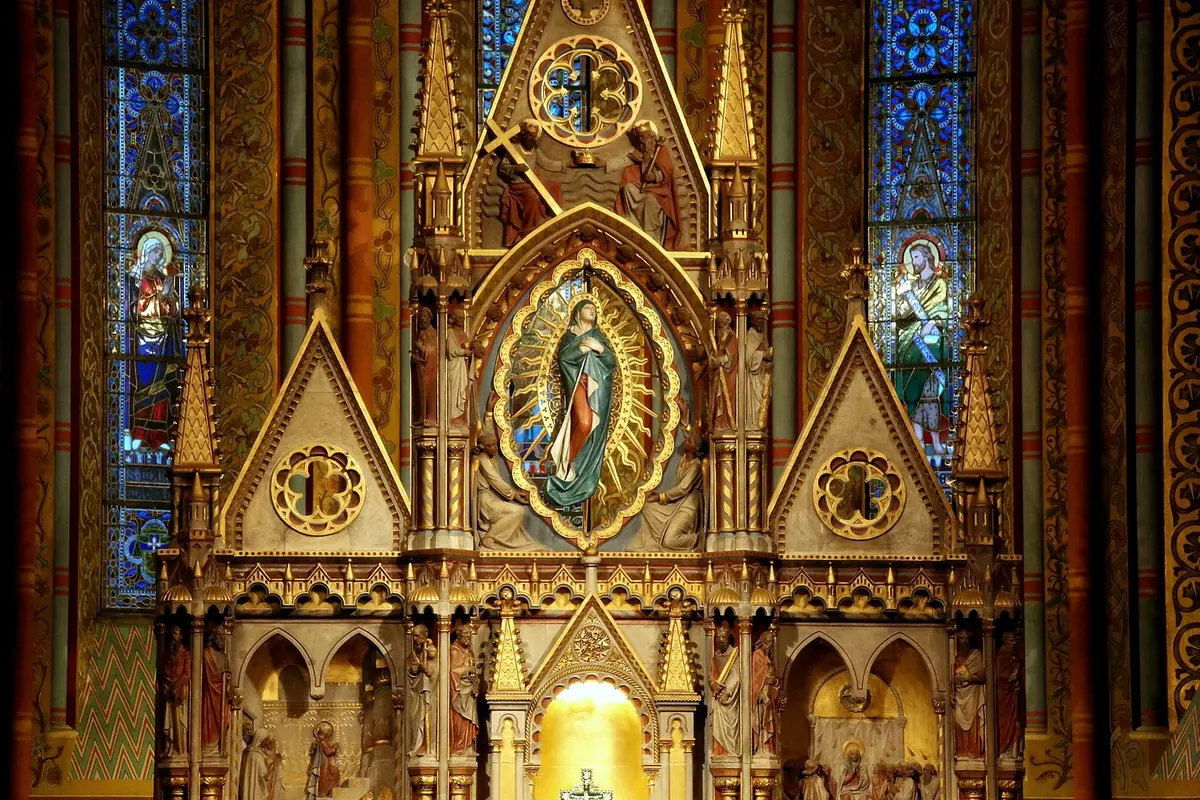
Restoration began in 1873 or 1874, depending on the source, under the architect Frigyes Schulek, and ran into the 1890s. The painters Bertalan Székely and Károly Lotz directed the interior decoration with him, using the remains of the medieval wall paintings, and painted the figurative murals themselves. Schulek is also credited with the diamond-pattern roof tiles, and he designed the Fisherman's Bastion beside the church. The result is the church most visitors see today, a Gothic building seen through the taste of the late 19th century.
1916 and after
Charles IV and Zita of Bourbon-Parma were crowned on 30 December 1916, the coronation of the last king of Hungary. The ceremony was filmed, and it is the only Hungarian coronation documented on film. During the siege of Budapest in 1944–45 the church was severely damaged. Restoration began in 1954 and lasted into the 1970s, and the repaired organ was opened in January 1984. The church has since returned to concerts, services and visitors, and its stage is now a place for classical music as well as ceremony.
Frequently asked questions
When was Matthias Church founded?
The church's own history page places it in 1246 or 1247. Wikipedia credits Béla IV with a basilica built between 1255 and 1269.
Why is it called Matthias Church?
It is named after King Matthias Corvinus, who had the tower rebuilt and married twice in the church.
Was it ever a mosque?
Yes. It served as a mosque from 1541 until allied forces retook Buda on 2 September 1686.
Sources